Mobile scrap shears CNS
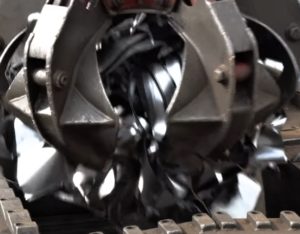
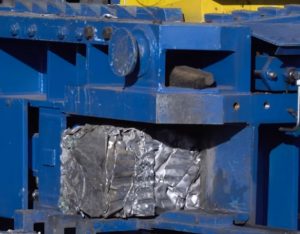
CNS – mobile scrap shears with shearing capacity from 800 to 1600 tonnes and two options of drive – diesel or electric. CNS characteristics are easy transportation, simple control and unique technical solution.

CNS – mobile scrap shears with shearing capacity from 800 to 1600 tonnes and two options of drive – diesel or electric. CNS characteristics are easy transportation, simple control and unique technical solution.

CNS – mobile scrap shears with shearing capacity from 400 to 730 tonnes and two drive options – diesel or electric. CNS characteristics are easy transportation, simple control and unique technical solution.
The CNS 400 K container scrap shears are designed in such a way to be able to transport them easily as a container on a four-axle truck or on a towed trailer equipped with the pull-on device.
The CNS 400 K container scrap shears are designed in such a way to be able to transport them as a container acc. to DIN 30722. After having been unloaded on even concrete surface, the shears can immediately work with help of the loader, which driver remotely controls even the shears operation.
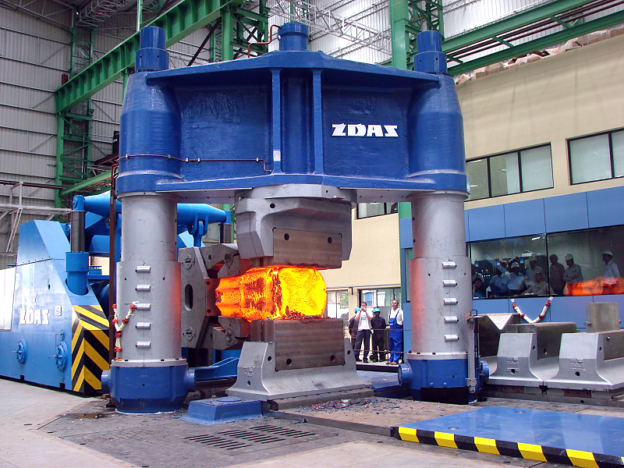
The hydraulic forging press CKW is a vertical, two‑column, pull‑down hydraulic forging press with a movable frame, designed for open‑die forging of heavy forgings. The CKW press combines a robust structural design with precise guidance and advanced tooling equipment, making it a universal forging machine for demanding forging operations.
The press is equipped with a traversing table, lower tool magazine, lower tool shifting mechanism, and an upper tool clamping mechanism, which together provide high technological flexibility and allow fast tool handling during the forging process.
The movable frame of the CKW forging press consists of an upper cross beam, lower cross beam and two columns, which are interanchored by two anchors. The columns have a square cross‑section and are protected in the working space by shields against thermal radiation from the hot forgings being processed.
The anchors pass through the hubs of the cross beams and through the central bores of the columns. They are prestressed by hydraulic nuts, ensuring high structural rigidity and long‑term stability of the entire press frame.
The middle cross head is a key supporting member of the press. It is mounted on two foundation beams, which are installed in special foundation bearings running in polymer concrete. This arrangement provides effective damping of dynamic loads and contributes to stable press operation even under high forging forces.
The columns of the movable frame are guided by flat guides mounted in guide bodies screwed to the upper and lower parts of the middle cross head. The large distance between the upper and lower guides significantly reduces guide reactions in the event of eccentric press loading.
Increased operating clearances caused by wear of the guide bronze plates can be compensated by inserting shims of the required thickness beneath the plates, which simplifies maintenance and extends service intervals.
The press is equipped with an oil circulation lubrication system, which continuously removes impurities from the guide areas. This system significantly extends the service life of the guide bronze plates and reduces wear of guiding surfaces.
The working force of the press is generated by one main press cylinder, which is built into the middle cross head. The press plunger is fastened to the lower cross beam of the movable frame, mounted on a spherical lens, and allows limited lateral movement to compensate for slight misalignments during forging.
The reverse movement of the movable frame is ensured by four piston‑type return cylinders. These cylinders are attached to the hubs of the middle cross head, while the piston rods are connected to the hubs of the columns of the lower cross beam. Both cylinders and piston rods are fastened by pins with spherical bearings, allowing reliable operation under variable loading conditions.
The CKW hydraulic forging press is equipped with a longitudinal feed table, lower tool magazine and lower tool shifting mechanism, which makes the press a highly versatile forging machine suitable for a wide range of open‑die forging operations, including forging of shafts, blocks, rings and other heavy components.
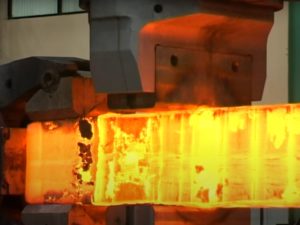
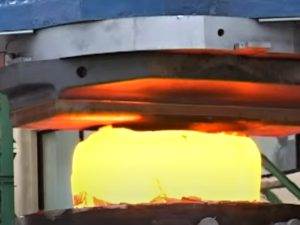
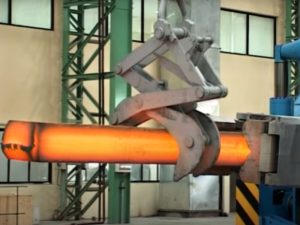
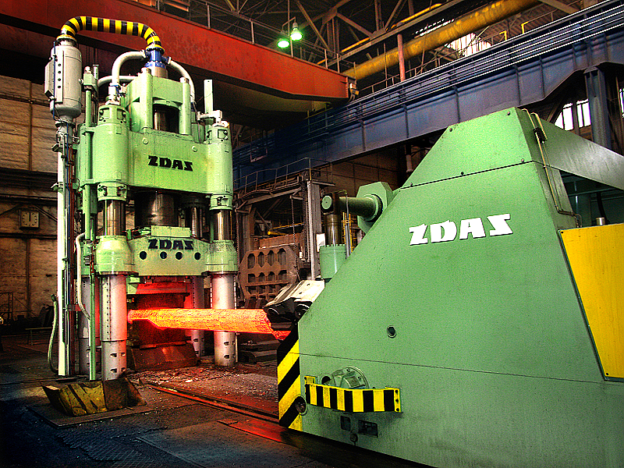
CKV forging presses are push‑down four‑column hydraulic forging presses designed for open‑die forging of heavy forged components. These presses are developed and manufactured by ŽĎAS, a.s., one of the leading European suppliers of equipment for heavy forming, forging and metallurgical applications.
The CKV press series covers a wide range of machine sizes with nominal forming forces from approximately 6.3 MN up to 140 MN, corresponding to about 630 to 14,000 tonnes. CKV presses are intended for open‑die forging of ingots, shafts, blocks, rings, discs and complex shaped forgings made of carbon, alloyed and high‑alloy steels.
CKV forging presses feature a four‑column frame structure with a hydraulic push‑down forming action. This design ensures high frame rigidity, uniform force distribution and stable machine behaviour even under extreme forming loads. Depending on the configuration, the press can operate in manual, semi‑automatic or fully automatic modes, allowing adaptation to different production requirements.
CKV presses can be supplied as stand‑alone machines or as part of a complete integrated forging unit, including rail‑bound forging manipulators, rotary tables, ingot carriages and auxiliary equipment. Such integrated solutions significantly increase productivity, process safety and repeatability in heavy forging operations.
CKV forging presses may be equipped with ŽĎAS TechForge automation software, which enables automated control of the forging process based on predefined technological recipes. This system provides:
This level of automation makes CKV presses suitable for modern forging shops where high productivity and stable quality are essential.
CKV forging presses are typically used in:
Forged components produced on CKV presses may weigh from several tonnes up to tens of tonnes, depending on press size and configuration.
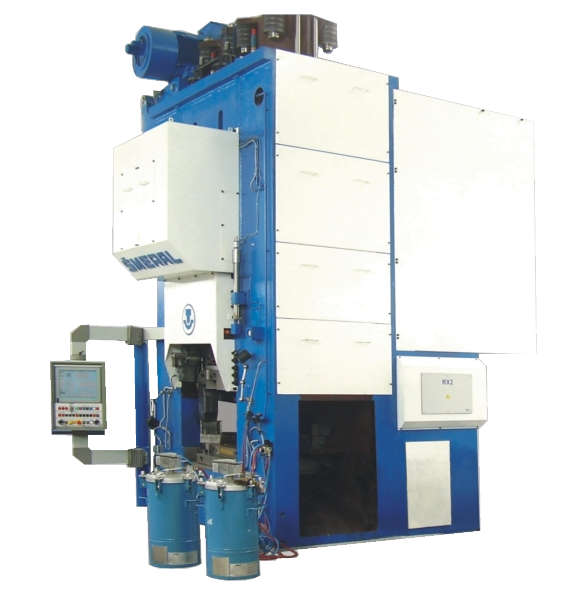
The vertical forging press LMZ press is designed with the well-tried cross arrangement of the eccentric shaft. Radial plays in the eccentric shaft seating are eliminated by specially adapted bearings and their sprung seating in the frame, the play in the axial seating is eliminated by a friction ring. The press frame is a mono-block of cast steel. The torgue from the elmotor is transferred by V-belts on the countershaft and from it by a pinion to the gear. In this gear the disc clutch is built-in which, after discs clamping, transfers the torgue by the clutch hub on the eccentric shaft where the disc brake is assembled on the other end. The brake is cooled by water. The cluch is driven by pressure air. The ram moves in slide guidings. It is forced to motion by the eccentric shaft through the connecting rod. In the frame upper part the ram balancing device is assembled which eliminates plays of the crank mechanism. To the connecting rod the ram is coupled by the eccentric pin. The ram can be adjusted hydraulically by turning of this pin. The hydraulic device serves also for the press releasing from contingent jamming. Any spontaneous adjustment is prevented by a face toothing. Any required disconnection is carried out by the hydraulic cylinder. The hydraulic circuit has got its separate source of pressure liquid. The upper and lower ejectors (cross-section B-B) are pneumatic with three ejecting pins. The tandem arrangement of the lower ejector cylinders is delivered as an item of optional accessories, with the standard execution only one cylinder is applied.
Against possible damage at a repeated overloading the press is protected by the force measuring device and the electronic protection which will stop the press at the moment when the press frame is lengthen over the preset limit. The vertical forging press is equipped with the blocking device which does not allow the press start in case the flywheel speed has dropped seriously down or in case air pressure has fallen down for the clutch clamping. The press is also equipped with special thermal protection of its main bearings. If heated above preset limit, the electric system prevents further machine start and the defect is signalled on the machine control panel.
The vertical forging press LMZ is lubricated by two separate automatic systems.
The grease lubrication – waste type (for guidings and ram balancing).
The central oil lubrication – lubrication of other important points and mechanisms is of circulatory type.
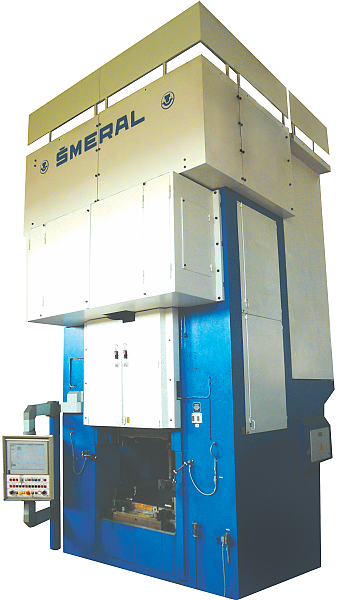
Vertical forging press LZK is used for production of precise die forgings with utilization in the automotive industry, for hot and semi-hot forging with forming forces of 10-65 MN, with high stiffness and extensive diagnostics, including modern, precise and solid fixtures and other extensive equipment.
Frame is casting from one piece of casting steel, it is thermaly treated for eliminating of the material tension. His firm box design does not ask for using of anchors. Ram is casting from one piece of alloyd steel for castings. The leading of ram in laths of the frame has shape „O“. Ram adjustment is driven by a hydraulical mechanism and i tis controlled by buttons from controlling panel. Countershaft is placed in the upper part of the frame on the right side in the sliding bearings. Countershaft is placed in upper part of the frame on right side in sliding bearings.
The press is equipped by multi-plate frictional clutch, which is controlled by electropneumatical valve. The press is equipped by multi-plate frictional brake also, which is controlled by electropneumatical valve. Used frictional material is asbestosless. The press is equipped with upper pneumatic and lower hydraulic ejectors. Power of the lower hydraulic ejector is 800 kN with stroke 60 mm.
The lower hydraulic ejector conducts 5 stroke per minute with maximal power. Power of the upper pneumatic ejector is 130 kN with stroke 50 mm. Basic span of pegs of both ejectors is 380 mm. The press is equipped with an automatical independent oil circulatory lubricating system of sliding bearings of crank mechanism and with an automatical independent fatty lubricating system of laths of ram guiding and of die holder. Hydraulic system of the press is utilized only for ram adjustment. Pneumatical system of the press works with the air pressure from the distribution system of the forging plant.
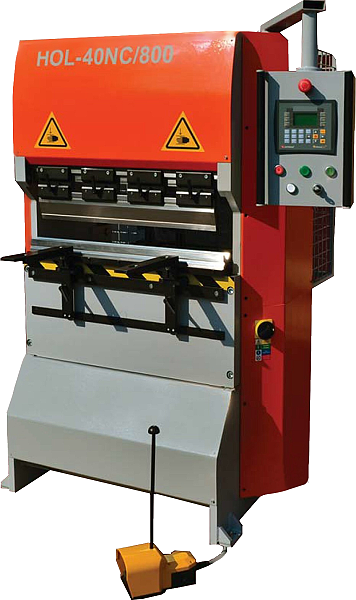
HOL 40 NC is hydraulic edging press dedicated for bending of sheet metals or strips.
There is posibility to equip the machine with:
HOL 40NC – the edging press is controlled by means of programmable automatic units UNITRON VISION V280 and all press models are determined by a program in the control automatic unit.
Simple operation, easy maintenance and efficiency bending at low cost. Stable construction made of high quality solid steel.
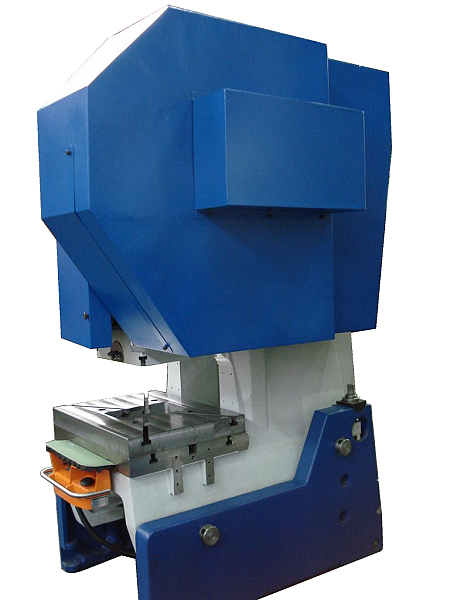
LEN and LEXN service and spare parts are provided for eccentric (excentric) presses manufactured by TOMA Trading (Slovakia). These presses were designed for cold forming of materials and were widely used in piece, small‑batch and serial production.
The range includes models LEN 10, LEN 25, LEN 40, LEN 63 and LEXN 100 C, which were known for their robust construction, high operational reliability and long service life. The machines were commonly installed in industrial plants focused on sheet‑metal forming and strip processing.
The LEN and LEXN eccentric presses were intended for cold forming operations, especially for technologies such as:
Thanks to their design, the presses were suitable both for standalone operation and for integration into complex production processes.
Earlier generations of LEN presses were built on a robust cast‑iron frame, which ensured high rigidity, stable operation and long‑term durability. These machines were characterized by simple but very durable construction and low maintenance requirements.
In later stages of development, the manufacturer responded to new production trends by introducing presses with a modern welded frame design, especially in the LEXN series. This solution brought:
The LEN and LEXN presses could be integrated into automated production lines. They were commonly combined with peripheral equipment such as:
This flexibility made the presses suitable for modern production environments with high productivity requirements.
Production of LEN and LEXN eccentric presses has been discontinued. The manufacturer, TOMA Trading, is currently in insolvency, and therefore these machines are no longer available as new equipment.
However, a significant number of presses are still in active industrial use, which creates continuous demand for service, spare parts and technical support.
Despite discontinued production, we continue to provide LEN and LEXN service and spare parts for operating machines, including:
If required, we can also recommend a suitable alternative press from another manufacturer with comparable technical parameters and intended application.
LEN and LEXN eccentric presses have been widely used in:
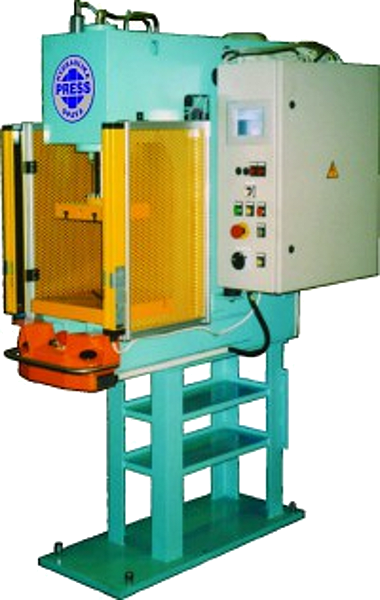
ZHW – simple bench hydraulic press with opened frame in “C” shape. The press is usable for assembly work, punching, bending, riveting, cutting, straightening and marking. Their sufficient pressing force enable to shape mainly metal materials with a small cross section. Despite their small dimensions, they have characteristic features of large presses – especially three ram control speeds with ability to control them. According to customer requirements the presses are supplied with standard or special accessories.

OHA 50 CNC 5 – vertical gear shaping machine with SINUMERIK 840 D control system ensuring control of five axis, and with digital servo-drives of controlled axis is very powerful universal shaping machine intended for shaping of inner and outer gearing of face gears with straight and helical teeth. Besides control of individual axis the system ensures control of all functions of the machine, course of automatic working cycle and fault and operation diagnostics.
The machine may shape also various curved disks, geared segments, and with special accessory also racks to length of 1000 mm. Up to 20 cuts may be selected for each shaping. Optimal cutting conditions may be selected for each cutting. Other machine versions enable the enlarged properties of the machine. Great working extent and applications determine this machine especially for piece and small lot production. The gear shaper OHA 50 CNC 5 with its conception and advantageous design fulfils the requirements of modern industry due to power, accuracy and machined surface quality.